
Evidence. Insight. Integration.
Explore the core components of the Rhythm Mapping™ coherence framework.

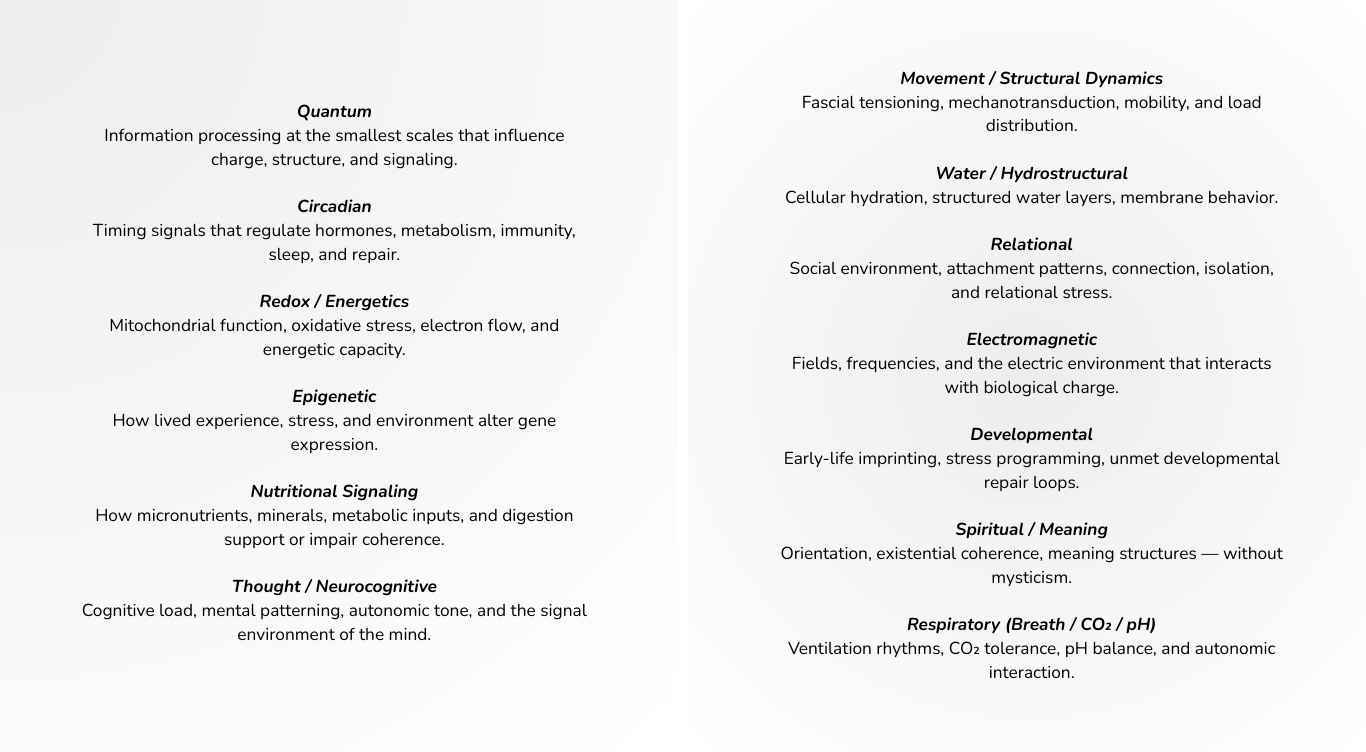
The 13 Signal Domains™
The entry point of information.
Human biology communicates through 13 interconnected domains. These domains show where coherence is held, strained, or lost.
Endocrine–Circadian Axis
Hormonal timing, adrenal patterns, thyroid regulation, sleep–wake coherence.
Neuro–Immune Axis
Neural signaling, inflammatory tone, microglial activity, autonomic balance.
Metabolic–Nutritional Axis
Glycemic control, insulin signaling, micronutrient availability, metabolic flexibility.
The Six Functional Axes
The corridors of signal distribution.
Your charge, stability, and coherence depend on how these axes interact.
Methylation–Detox Axis
Methyl donors, detox pathways, liver processing, oxidative load.
Structural–Mechanical Axis
Fascial architecture, posture, load distribution, mechanotransduction.
Inflammatory–Redox Axis
Mitochondrial stress, redox signaling, reactive species, antioxidant capacity.

Signal - the language of communication
Information flow across systems.
Charge - the currency of energy
Energy availability and electrical gradients.
Structure - the architecture of transmission
Fascial tensioning, tissue dynamics, hydration layers.
Rhythm - the timing sequence
Timing signals that coordinate everything from hormones to cognition.
Coherence Architecture
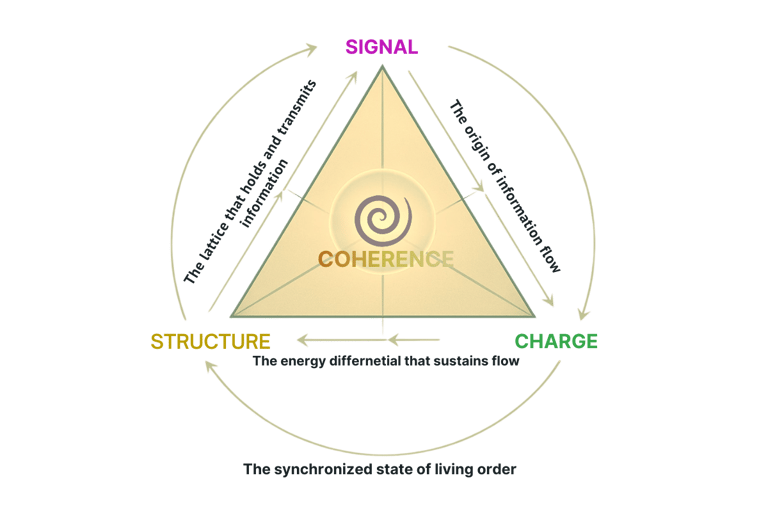
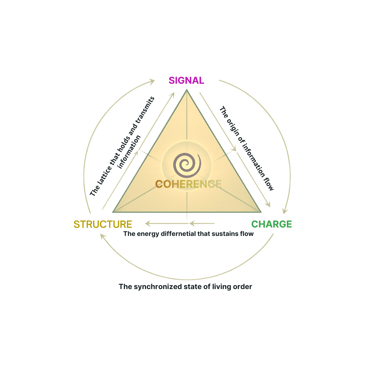
All biological patterns can be understood through four interacting layers:


Coherence is the state of alignment across these layers, reflected as synchronized function, efficiency, and adaptability.
Rhythm Mapping identifies where one or more layers diverged, and how that divergence shaped your current pattern.
Rhythm Mapping identifies:
• where the disruption began
• how your system adapted
• where the overload occurred
• how symptoms formed
This explains patterns like:
• thyroid suppression driven by circadian mismatch
• insulin resistance driven by redox stress
• hypertension emerging from autonomic timing collapse
• chronic fatigue emerging from mitochondrial overload
Upstream → Downstream Sequencing
Symptoms rarely originate where they appear.
Biology follows a sequence:
Upstream Disruption → Compensation → Overload → Downstream Expression
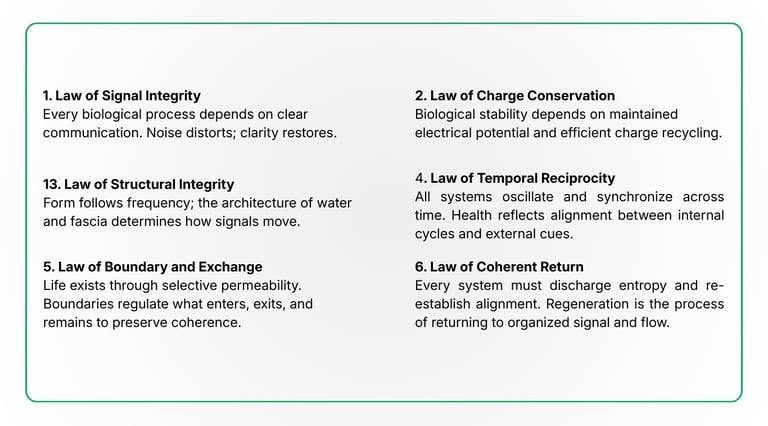
The Six Containment Laws of Biological Coherence™
1. Signal Integrity
2. Charge Conservation
3. Structural Integrity
4. Rhythmic Coordination
5. Boundary & Exchange Regulation
6. Coherent Return
These laws govern all biological adaptability and coherence.
Our Scientific Foundation
Systems Biology (Hood L., Science) — shows that health and disease emerge from network-level interactions.
Chronobiology
(Reppert & Weaver, Nature Reviews Neuroscience) — demonstrates that timing controls physiological regulation.
Redox Physiology & Mitochondrial Dynamics
(Picard & Wallace, Cell Metabolism) — reveals how energy, signaling, and cellular stress shape system-wide behavior.
Network Physiology
(Ivanov et al., Nature Communications) — establishes that organs and systems coordinate through dynamic, multi-scale interactions.
Developmental Programming
(Meaney & Szyf, Nature Neuroscience) — shows how early-life signals imprint long-term patterns.
Environmental Medicine
(Balasubramanian et al., The Lancet Planetary Health) — confirms how environmental mismatches alter biological coherence.
Trilogi’s framework integrates well-established scientific disciplines, including:
These fields support the foundation of what Trilogi interprets: the continuity, sequence, and pattern of human biology.


Trilogi Wellness creates educational frameworks for informational purposes only. Rhythm Mapping™ is an analytical framework designed to support personal understanding of biological patterns and can be integrated alongside appropriate medical care. It does not diagnose, treat or replace medical evaluation, treatment, and management. If urgent symptoms, seek medical attention.
Get access to Trilogi's Coherence Vault.
Receive occasional dispatches when new Archive work or framework clarifications are released.
We don't unpack these on social.
Trilogi Wellness © 2025. All rights reserved